
Blood profiling
Finger-prick or venous blood tests: what does Inuvi’s evidence tell us?
Both collection methods can be useful. The right choice depends on the marker, the collection tube and how the sample reaches the laboratory.
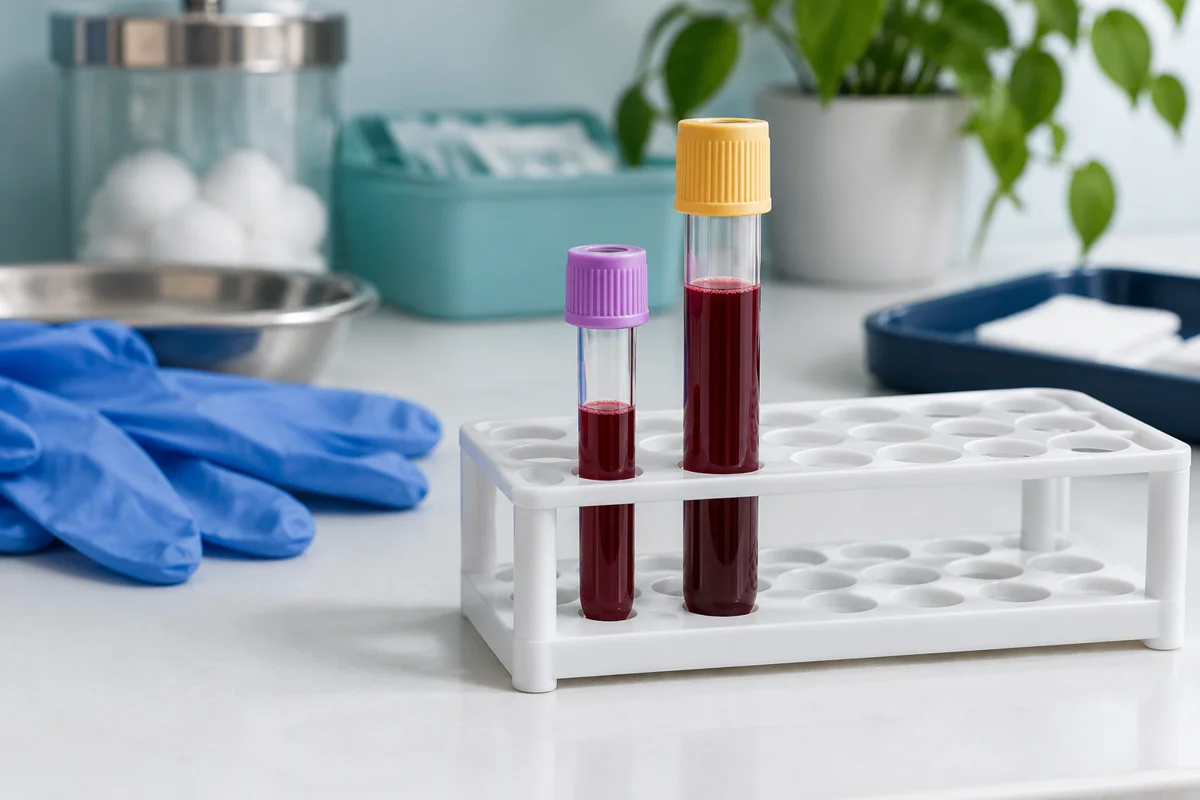
Two ways to collect a laboratory sample
A finger-prick test collects a small capillary blood sample using a lancet. A venous sample is drawn from a vein by a trained professional. With the services discussed here, both are sent to a laboratory for analysis; a home collection kit is not an instant home diagnosis.
Inuvi, the laboratory used for Beaches blood profiles, offers both routes and describes verification work comparing capillary testing with venous testing. That supports appropriate finger-prick testing, but does not mean every blood marker or collection kit is interchangeable. [1]
What the creatinine research found
A 2023 study involving Inuvi researchers compared self-collected capillary samples with professionally collected venous samples for creatinine, a marker used when assessing kidney function. Using an enzymatic laboratory method, results were comparable, including after unseparated samples had been stored at room temperature for three days. [2]
This was a small feasibility study of a specific marker, method and handling process. It supports that particular use of capillary sampling; it does not establish that every postal blood test remains accurate for three days, or that every kidney marker behaves like creatinine. The authors were affiliated with Inuvi and Thriva, which is relevant context when reading the findings.
For hormones, the tube matters too
Research involving Inuvi, Hertility and University College London compared capillary samples collected into tubes with and without serum-separator gel. In 14 premenopausal women, with 34 paired collections, gel-containing tubes produced lower oestradiol and total testosterone measurements. Other hormones tested did not show the same statistically significant difference. [3]
This was principally a comparison of two capillary tube types, not proof that all finger-prick results are lower than venous results. It also cannot establish the size of any effect in men being assessed for low testosterone. The practical message is that a validated tube-and-test combination matters. Do not substitute a different collection tube or transfer blood between tubes.
Why a sample sometimes needs repeating
Inuvi’s publicly available laboratory guide, issue 17, describes several limitations. Damage to red blood cells (haemolysis) can affect selected markers; clotting can prevent useful full blood count or HbA1c results. Some markers, including potassium, require timely processing and are unsuitable for ordinary postal capillary collection. [4]
The guide also recommends plain serum capillary tubes for sex hormones and warns about contamination from skin products, including topical hormone treatments. Follow your supplied kit instructions and tell the clinician about creams, gels and medicines. Do not stop prescribed treatment without advice. [4]
An unusable sample is different from a confirmed abnormal result. Either may require follow-up, but repeating a sample because of collection quality does not itself mean that a health problem has been found.
Which option fits your Beaches profile?
Finger-prick collection is offered for selected Beaches profiles, including Male Hormone Profiling, Advanced Thyroid Function and Iron Profiling. It may be convenient when the required panel is available through that route. Ultimate Performance, Advanced TRT Blood Analysis and several broader profiles are venous-only in our current catalogue. Check the collection options on the individual test page. [5]
Choose the profile around the clinical question first, then choose an available collection method. For prescribed-treatment monitoring, ask the responsible clinician which panel, collection route and timing they require. A convenient test is only useful if it supplies the information needed for the decision.
Our practical approach
Follow the preparation and dispatch instructions supplied for your exact test. If collection is difficult, a previous sample was unsuitable, or you are unsure which route to use, contact Beaches before ordering. Results need to be considered alongside your symptoms, history and reason for testing.
This article summarises published research and Inuvi’s publicly accessible guidance; it is not an independent validation of every Beaches kit or assay. The technical guide cited is issue 17, and current instructions from Inuvi for your particular kit take precedence. Sources accessed 8 November 2026.
Sources and further reading
- 1. Inuvi — Laboratory Services and capillary testing verification
- 2. Woolley, Rutter & Staudenmaier (2023). Creatinine comparability and stability. British Journal of Biomedical Science, 80:11402.
- 3. Vasavan et al. (2024; online 2023). Capillary collection tubes, oestradiol and testosterone. Clinical Chemistry and Laboratory Medicine, 62:e84–e87.
- 4. Inuvi — Guide for Laboratory Users, issue 17, especially pages 21–22.
- 5. Beaches — Current blood profiles and available collection routes
This article provides general education only. It cannot account for your health history, examination or individual circumstances. Seek appropriate professional advice if you are concerned about symptoms.